
How to Fix Scratches on Wooden Furniture
Run a fingernail across the scratch. If it doesn't catch, the damage is in the finish and you can fix it in an afternoon. If it catches, you're into the timber and the job changes.
That single test decides which of the four sections below applies to you.
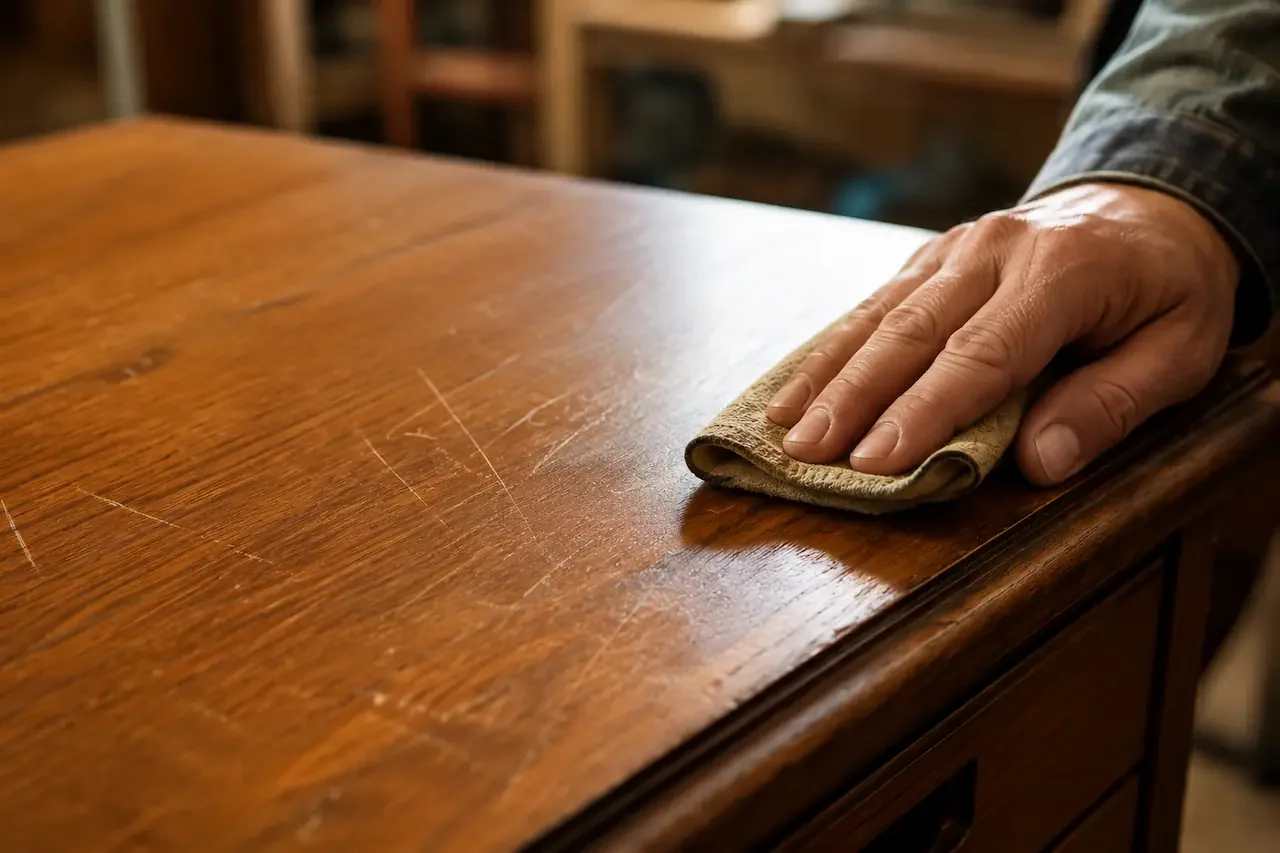
1. Scratches in the Finish Only
Your fingernail glides over it. The mark looks pale or dull rather than deep.
Clean the area with a barely damp cloth and let it dry completely.
Rub along the grain with a soft cloth and a small amount of the same finish already on the piece — oil on an oiled surface, wax on a waxed one.
Leave it fifteen minutes, then buff with a clean dry cloth.
Repeat once if the mark still shows.
Most scratches people worry about are this. The finish has been scuffed, not broken.
2. Scratches Through to Bare Timber
Your fingernail catches, and the scratch is a different colour to the surface around it.
Clean and dry the area.
Sand lightly along the grain only, starting at 320 grit. Stop as soon as the edges of the scratch soften. Never sand across the grain.
Colour-match on an offcut or a hidden area first. Timber darkens as finish goes on, so what looks right dry will look wrong wet.
Apply colour sparingly, building up rather than correcting.
Seal with the same finish as the rest of the piece, feathering out past the repair.
Colour matching is the hard part and the part worth practising on something you don't care about.
3. Deep Gouges
The damage has removed timber rather than marked it.
Clean out any loose fibres.
Fill with a timber-compatible filler tinted slightly lighter than the surrounding wood.
Let it cure fully — longer than the tin says.
Level with 320 grit on a flat block, working along the grain.
Colour and seal as above, then refinish the whole panel rather than the patch. A perfect repair in the middle of an old finish still reads as a repair.
4. Scratches in Veneer
This is where to stop.
Mid-century veneer is often under a millimetre thick. Sanding a scratch out of it usually means sanding through it, and once the substrate shows there is no repair that doesn't involve replacing the whole sheet.
If you're not certain whether you're looking at solid timber or veneer, check an edge or the underside of a drawer front. If you can see a thin decorative layer over a different material, treat it as veneer and don't sand it.
Veneer repair is one of the few jobs I'd always recommend handing over.
Final Thoughts
Scratches on wooden furniture are completely normal, especially in everyday use. The good news is that most damage can be repaired with the right techniques and attention to detail.
Working out of Northcote, I've brought back even heavily scratched pieces to a beautiful, natural finish it's rarely as bad as it first looks.
Why Melbourne Homes See More Scratches Than You'd Expect
A lot of the scratch damage I repair comes down to how Melbourne homes are built and lived in. Polished timber floorboards, common across the older weatherboard and terrace homes in the inner north, mean furniture legs drag more easily than on carpet. Open-plan living areas with dining tables doubling as workspaces add daily wear that timber from the 1950s-70s just wasn't built for. If a piece is too large to bring in, I offer pickup across Northcote, Fitzroy, Thornbury, Preston and the wider Melbourne area, so you don't need to move it yourself.
What Not to Use
The home remedies that come up most often, and what they actually do.
Mayonnaise, olive oil, walnut meat. These darken the scratch temporarily and leave a residue that interferes with any proper repair later.
Furniture polish in a spray can. Silicone contamination. It makes refinishing significantly harder and it is difficult to remove.
Coloured wax sticks used alone. Fine as a short-term cover, but they sit on the surface and pick up dirt.
Sanding across the grain. Leaves scratches that only appear once the finish goes on.
None of these ruin a piece on their own. They just tend to turn a small job into a larger one.
When to Stop
Hand it over when the piece is veneered, when it carries a maker's mark, when the damage crosses a joint, or when it matters enough to you that getting it wrong would be worse than paying someone.
Send photographs and I'll tell you which of the four sections above applies to your piece, and whether it's worth doing yourself. There's no cost for that. Get in touch.
FAQs
1. Can scratches on wooden furniture be fully removed?
Yes, most scratches can be repaired or significantly reduced depending on depth.
2. Do I need professional restoration for small scratches?
Not always—light scratches can often be fixed at home with polish or wax.
3. Can deep scratches damage furniture permanently?
If untreated, deep scratches can worsen, but they can usually be repaired.
4. Is sanding always required for scratch repair?
No, only deeper damage requires sanding during restoration.
5. How do I prevent scratches on wooden furniture?
Use protective mats, avoid dragging objects, and maintain regular polishing.