
Why Proper Mid-Century Restoration Is About Restraint, Not Reinvention
Mid-century furniture was designed with clarity. Its character comes from proportion, material honesty, functional construction and finishes that allow the timber to remain central to the design.
Many original pieces now arrive in the workshop carrying decades of use as well as earlier attempts to improve them. Thick coatings, dark stains, visible screws, unsuitable adhesives and excessive sanding may have changed the furniture more than age itself.
Proper mid-century furniture restoration in Melbourne should not impose a new identity on these pieces. It should determine what remains original, what has failed and what can be corrected without removing the qualities that make the furniture recognisable.
At Mid Century Restoration, my approach is based on restraint. That means repairing what is unstable, refining what has deteriorated and leaving appropriate signs of age where removing them would cause unnecessary loss. The goal is not to make the piece look newly manufactured. It is to help it look balanced, functional and true to its design again.
What Restraint Means in Furniture Restoration
Restraint is not a lack of workmanship. It is the discipline of choosing the least invasive method capable of producing a sound result.
A restorer may have the tools to remove every coating, sand every mark and replace every imperfect component. Craftsmanship lies in deciding whether those actions are actually appropriate.
Some furniture needs substantial structural and surface work. Other pieces may require only cleaning, localised repair and careful finishing. Applying the same process to both would ignore their different materials, histories and conditions.
Preserving Evidence of Age
Patina can include gentle colour variation, softened edges, minor marks and changes created through normal handling and light exposure.
These characteristics are not always defects. They can show how the furniture has aged and contribute to the depth of the timber.
Active deterioration is different. Loose joints, lifting veneer, unstable cracks, failed coatings and moisture damage need attention because they can continue to worsen.
Restoration with restraint distinguishes between the two. It corrects deterioration without automatically erasing every sign that the piece has been used.
Restraint Does Not Mean Leaving Damage Untreated
A preservation-focused approach should not become an excuse to ignore instability or poor condition.
A loose chair joint will not improve through gentle cleaning. Lifting veneer will not become secure because its patina is attractive. A failed coating may leave timber vulnerable to continued wear.
Restraint means carrying out the necessary work accurately while avoiding unrelated or excessive alteration.
Understanding the Original Design Language
Before restoring a piece, it is important to understand how its individual parts work together.
Mid-century furniture often uses clean lines, narrow profiles, tapered legs, recessed bases and controlled transitions between solid timber and veneer. These details create an appearance of simplicity, but they depend on accurate construction.
Changing one element can affect the whole piece. Rounding a defined edge through over-sanding, fitting oversized hardware or darkening the timber excessively may make the furniture feel heavier and less balanced.
Proportion Should Guide Repair Decisions
A replacement leg or rail may be structurally strong but still look wrong when its thickness, angle or grain does not suit the original design.
Similarly, an added bracket may stop movement while introducing a visible component that changes how the furniture was intended to appear.
A considered repair works within the original proportions wherever possible. New material should support the furniture rather than become visually dominant.
Materials Reveal How the Piece Should Be Treated
Solid timber, veneer, plywood, laminated components and manufactured substrates may all appear in one item.
Each material responds differently to moisture, sanding, adhesives and finishing products. The visible surface of a sideboard may be teak veneer, while its edges and legs are solid timber. Treating the entire piece as solid wood could result in permanent damage.
Original construction details should therefore be identified before cosmetic work begins.
Assessment Must Come Before Intervention
The first restoration stage is diagnosis, not sanding.
The furniture should be examined as a complete object so the visible wear can be understood alongside its hidden structure and previous treatment.
A professional assessment may consider:
Timber species, veneer thickness, grain direction and original edge profiles
Loose joints, frame movement, splits and weakened load-bearing components
Existing finishes, polish residue, stains and later coatings
Previous repairs, replacement hardware and added structural components
Labels, stamps and original details that require protection
The owner’s intended use and expectations for the completed piece
These observations determine whether the project needs structural repair, cleaning, finish correction, veneer work, broader refinishing or a limited conservation approach.
Previous Repairs Can Change the Restoration Plan
Many mid-century pieces have already been altered.
Screws may have been driven into loose joints. Modern adhesive may have been added without removing the failed material underneath. Veneer damage may have been covered with filler, stain or paint.
These interventions should be identified before they are disturbed. Removing a screw may expose a split. Disassembling a joint may reveal missing timber or an earlier repair that cannot be reversed completely.
A responsible restoration plan remains flexible enough to respond to what becomes visible during the work.
Structure Comes Before Surface Appearance
A polished surface cannot compensate for an unstable frame.
Chairs, tables and storage furniture rely on joints and hidden supports that may loosen gradually through use, movement and adhesive failure. The exterior can still look presentable even when the internal structure is weakening.
Refinishing an unstable piece first may also create additional work. The new surface can be marked or disturbed when the furniture later needs disassembly, alignment and clamping.
Loose Joints Require More Than Added Glue
Applying glue around the outside of a joint may reduce movement temporarily, but it does not necessarily restore the original connection.
Old adhesive, contamination or worn material may remain inside. The joint may also be out of alignment.
Where appropriate, the affected area should be carefully disassembled. Failed adhesive can then be removed and the components inspected before the joint is repaired and reassembled under controlled pressure.
Professional furniture repair and structural restoration addresses these underlying faults before the final appearance becomes the focus.
Structural Repairs Should Remain Visually Quiet
A repair does not need to be invisible in every circumstance, but it should not distract unnecessarily from the furniture.
Oversized brackets, exposed screws and poorly matched replacement timber can change the piece even when they improve short-term stability.
The aim is to return strength and function while retaining original components and construction wherever practical.
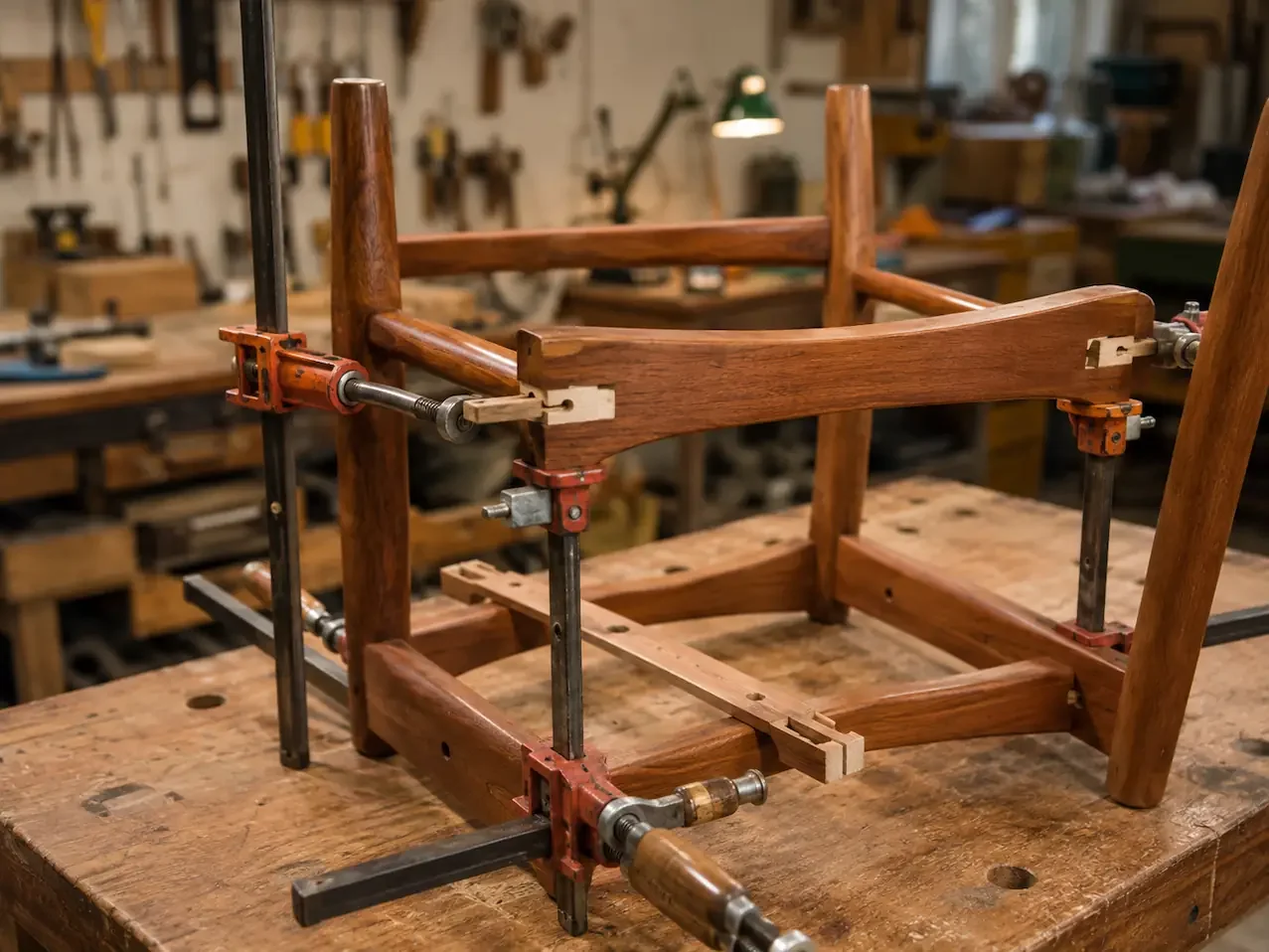
[IMAGE PLACEMENT: Add an image after the structural-restoration section.]
Suggested image subject: A mid-century chair frame carefully disassembled, aligned and clamped during a joint repair.
Image purpose: Show the hidden craftsmanship completed before refinishing.
Recommended alt text: Structural mid-century furniture repair before refinishing
Surface Preparation Should Remove as Little as Necessary
Sanding is a useful restoration method, but it is frequently treated as the solution to every surface problem.
Each sanding pass removes original material. On solid timber, excessive work can soften edges and change profiles. On veneer, the margin for error may be very small.
Surface preparation should therefore begin with cleaning and testing. A faded or darkened area may be caused by polish, smoke residue or a later coating rather than deep damage in the timber.
Veneer Requires Particular Care
Quality veneer was widely used in mid-century cabinets, tabletops, doors and drawer fronts.
Its use was intentional, allowing makers to control grain patterns and create stable surfaces. However, the decorative timber layer may be thin.
Machine sanding can expose the substrate underneath or create uneven areas that absorb finish differently. Once veneer has been sanded through, the original surface cannot simply be restored by applying more oil or stain.
A restrained approach uses the least aggressive preparation suitable for the problem.
Not Every Mark Should Disappear
Deep scratches, dents and stains may not be removable without sacrificing too much timber or veneer.
In these cases, reducing the contrast of the damage may be safer than pursuing complete removal. Colour integration and controlled finishing can allow a mark to sit more quietly within the surface.
The quality of the result should be judged across the whole piece, not by whether one deep mark has been erased at any cost.
Finishes Should Be Chosen for the Piece, Not the Trend
The final coating affects colour, sheen, texture, protection and future maintenance.
There is no single finish that is correct for all mid-century furniture. The right choice depends on the timber, original surface, previous treatments and how the furniture will be used.
A frequently used dining table faces different conditions from a display cabinet. A finish that performs well on one surface may be unsuitable on another.
Thick Coatings Can Change the Furniture’s Character
Heavy, highly reflective coatings can flatten the appearance of the grain and alter the tactile quality of timber.
Dark stains can also obscure natural variation or make a refined piece feel visually heavy.
This does not mean that one category of modern coating is always wrong or that oil is automatically correct. Compatibility and intended use must be considered before a finish is selected.
Through careful teak and timber furniture refinishing, the existing surface can be assessed before deciding how much preparation is required and which finishing system is suitable.
Application Matters as Much as Product Selection
An appropriate product can still create a poor result when preparation or application is rushed.
Dust, contamination, uneven sanding and insufficient curing time can produce patchiness or inconsistent sheen. Heavy application may create excessive surface build or delay proper curing.
Thin, controlled work gives the restorer greater opportunity to assess colour and texture as the finish develops.
Recognising Signs of Over-Restoration
Over-restoration often occurs when the desired result is based on perfection rather than the original furniture.
Common warning signs include:
Rounded edges or softened profiles caused by aggressive sanding
Very dark stain applied to disguise uneven preparation or damage
Thick, glossy coating that overwhelms the timber grain
Modern handles or fittings that alter the proportions of the piece
Visible screws and brackets used instead of proper joint repair
Replacement components that do not match the original timber or construction
Uniform colour that removes all natural variation and age
These outcomes may initially appear clean or newly finished, but they can reduce material integrity and make future restoration more difficult.
Not Every Earlier Intervention Can Be Reversed
A thick coating may be removable, but the timber beneath may already have been aggressively sanded. Replacement hardware may have left additional holes. A previous structural repair may have removed or split original components.
A professional assessment should explain these limitations honestly.
The goal may be to improve the earlier work and recover visual balance rather than promise a complete return to the original condition.
Mid-Century Interiors Require the Same Restraint
The philosophy of restraint also applies to wall panelling, built-in cabinetry, ceilings, doors and internal joinery.
These features were often designed as part of one architectural composition. Covering or replacing them can change the proportions, warmth and continuity of the interior.
Professional mid-century home interior restoration works with the existing materials wherever practical rather than automatically imposing a new surface or modern aesthetic.
The Entire Room Must Be Considered
A timber wall should not be refinished without considering the cabinetry, floor, ceiling and surrounding architectural materials.
A colour or sheen that looks suitable on a small sample may feel too dark or reflective across a complete room.
Natural and artificial lighting also influence how the finish appears. Testing in the actual interior can prevent an isolated treatment from disrupting the wider design.
Subtle Work Often Produces the Strongest Result
A successful interior restoration may not appear dramatically transformed.
Instead, the timber feels more balanced, failed coatings have been corrected, loose components are secure and the room works as a coherent whole again.
That subtlety is evidence of restraint rather than a lack of improvement.
Restoration and Furniture Value
Owners often ask whether restoration will increase the value of a mid-century piece.
There is no universal answer. Value may depend on the maker, rarity, provenance, condition, originality, demand and quality of both earlier and current work.
Careful restoration can improve usability and presentation while protecting original materials. Inappropriate restoration may remove labels, alter proportions or cover the timber with a finish that informed buyers consider unsuitable.
Preservation Is More Reliable Than Promising a Return
A restorer should not guarantee that a project will increase the sale price of the furniture.
The more credible objective is to avoid unnecessary changes that diminish authenticity or reduce future restoration options.
Retaining original components, documenting major repairs and using a finish compatible with the piece can support informed ownership even when the market value remains uncertain.
When Replacement Is Actually Necessary
Restraint does not require preserving every damaged component regardless of condition.
Replacement may be necessary when material is missing, severely split, structurally unsafe or damaged beyond practical repair.
The decision should be based on function and material integrity rather than minor cosmetic imperfection.
Where an original part can be repaired safely, retaining it usually preserves more of the furniture’s history and construction.
When replacement is necessary, the new component should be shaped and selected to suit the original proportions, timber and grain direction.
The purpose is not to create a feature out of the repair. It is to allow the furniture to function without disrupting its design.
How to Choose a Mid-Century Furniture Restorer
Before committing a piece to restoration, ask how the restorer assesses materials, structure and previous work.
Useful questions include:
Do you regularly work with original mid-century furniture and veneered surfaces?
Will structural movement be assessed before refinishing?
How will you determine what coating is already on the furniture?
Can you explain what will be preserved and what must be changed?
Will you test the proposed preparation and finish before treating the full surface?
Who will complete the work, and will any part be outsourced?
Can you show examples with close-up repair and finishing details?
What limitations or remaining marks should I expect?
A trustworthy restorer should be prepared to discuss uncertainty and explain why one method is safer than another.
The mid-century restoration gallery provides examples of completed furniture and interior work where original materials and restrained finishes remain central to the result.
Learning the Principles of Restoration With Restraint
Furniture owners and enthusiasts often want to understand why certain methods are chosen, even when they do not intend to undertake a valuable restoration alone.
Practical learning can help people recognise veneer, identify structural movement and understand why preparation should not begin with aggressive sanding.
The mid-century furniture restoration workshops in Melbourne focus on real materials, restoration order and decision-making rather than treating every project as a standard refinishing exercise.
Learning when to stop is as important as learning how to use a tool.
Caring for Furniture After Restoration
Restraint continues after the furniture returns to use.
The surface should be maintained according to the finish applied during restoration. Abrasive cleaners, unknown oils and silicone-heavy polishes can contaminate the coating or make later maintenance difficult.
Spills should be wiped promptly, and frequently used surfaces should be protected from heat and standing moisture. Strong, prolonged sunlight may also cause uneven colour change.
When the surface begins to look worn, seek advice before adding a new product. A simple maintenance treatment may be appropriate, but an incompatible coating can create a larger restoration problem.
The Furniture Should Still Feel Like Itself
Proper restoration does not need to announce how much work has been completed.
The structure should feel secure, the surface should appear balanced and the materials should remain recognisable. Original details should not be buried beneath a restorer’s preferred style.
Restraint protects the furniture from both deterioration and unnecessary intervention. It accepts that age can contribute to character while recognising when damage must be corrected.
The strongest restoration result is not a piece that looks entirely new. It is a piece that feels complete, usable and faithful to the reasons it was worth preserving.
Discuss a Mid-Century Restoration Project in Melbourne
Before deciding whether a piece needs full restoration, gather clear photographs of the complete item, joints, damaged areas, undersides, edges, labels and previous repairs.
Richard Lloyd personally assesses mid-century furniture and interior projects in Melbourne. You can contact Mid Century Restoration to share photographs and receive clear guidance on what can be preserved, what requires repair and what may be better left unchanged.
The aim is to establish the right level of intervention before irreversible work begins.
Frequently Asked Questions
What does restoration with restraint mean?
Restoration with restraint means completing the work necessary for stability, protection and visual balance without altering unrelated original material. It prioritises repair, careful cleaning and controlled refinishing rather than automatically stripping, sanding or replacing every aged component.
Should all scratches be removed during restoration?
No. Light scratches may be reduced safely, but deep marks can extend into timber or thin veneer. Removing them completely may require excessive sanding. A restorer may recommend reducing their contrast instead of sacrificing original material.
Is patina the same as damage?
No. Patina generally refers to stable changes created by age, handling and light. Damage includes conditions such as lifting veneer, loose joints, active cracks, water ingress and failed coatings. The distinction depends on the individual piece.
Should structural repair happen before refinishing?
Usually, yes. Loose joints, unstable frames and failed earlier repairs should be addressed before final surface work. Structural repair may require disassembly and clamping that could disturb a newly refinished surface.
Are oil finishes always appropriate for mid-century furniture?
No. The correct finish depends on the timber, original coating, previous treatment and intended use. Oil may suit some pieces, while another compatible finishing system may be more appropriate for others.
Does professional restoration increase furniture value?
It may support condition, usability and presentation, but an increase in financial value cannot be guaranteed. Market value also depends on maker, rarity, provenance, originality, demand and the quality of previous work.