
How to Identify Genuine Mid-Century Furniture: Makers’ Marks, Stamps & Labels
When people ask me how to identify genuine mid-century furniture, they are usually looking for one clear answer. They want to know whether a makers mark, stamp, label, or hidden detail proves that a piece is authentic. I always explain that these clues are important, but they should never be judged in isolation.
In my Northcote workshop, I often assess furniture where the owner has found a small paper label, a faded stamp, or a number underneath a drawer and wants to understand what it means. I have seen firsthand that mid century furniture makers marks can help confirm authenticity, but the full story usually comes from combining those marks with construction, timber, design, hardware, condition, and provenance.
Authentic MCM furniture is not always perfectly labelled. Some genuine pieces have clear makers marks, while others have lost their labels over time. The key is knowing where to look, what to look for, and how to avoid common mistakes that can reduce the value of a piece.
Why Makers Marks Matter in Mid-Century Furniture
Makers marks matter because they can connect a piece to a designer, manufacturer, workshop, retailer, or production period. A clear mark can support authenticity, help with valuation, and guide the safest restoration approach.
A makers mark may appear as a paper label, ink stamp, metal badge, impressed mark, branded stamp, or handwritten production code. These marks are often found in discreet areas because furniture makers did not always design them to be highly visible.
In many cases, a mark can help answer important questions such as who made the piece, when it may have been produced, whether it belongs to a known range, and whether it has collectible value.
If you are trying to understand whether a piece deserves careful restoration, our guide on identifying valuable mid-century furniture explains how design quality, materials, and condition all work together when assessing long-term value.
I always advise clients not to clean, sand, or refinish a piece before checking for marks. A faded stamp or fragile label can be lost permanently if the furniture is handled too aggressively.
Where to Look for Mid Century Furniture Makers Marks
Makers marks are often hidden in places that people do not inspect carefully. Before assuming a piece is unmarked, check all structural and concealed areas with good lighting.
Common places to look include:
Underneath tabletops
Inside drawers
On the back of sideboards or cabinets
Under chair seats
Inside cupboard doors
Along drawer runners
On the underside of shelves
Behind removable panels
Under upholstery or fabric dust covers
On metal brackets or hardware plates
When checking these areas, use a torch and take clear photos before touching anything. Do not scrape, sand, or wet the surface to make a mark clearer. Many old stamps and labels are fragile, and once they are damaged, they cannot be recreated.
I have inspected pieces where a small paper label inside a drawer changed the entire understanding of the furniture. I have also seen pieces where no label remained, but the construction and design still strongly supported authenticity.
Types of Stamps, Labels, and Marks You May Find
Mid century furniture makers marks can appear in several forms. Knowing the difference helps you understand what you are looking at.
Paper labels are common on cabinets, sideboards, chairs, and tables. These may include the maker name, retailer name, model number, or country of origin. Over time, paper labels can fade, tear, or lift from the timber.
Ink stamps are often found underneath furniture or inside drawers. These may show a manufacturer name, production batch, quality control mark, or delivery code. Ink stamps can become faint, especially if the piece has been cleaned or exposed to moisture.
Metal badges or plaques are sometimes used on higher-end pieces or specific production ranges. These are usually attached with small pins or screws. Missing badge holes can sometimes suggest that a label has been removed.
Impressed or burned marks are more permanent. These may be stamped into timber or branded onto the underside of the piece. They can be useful because they are harder to remove than paper labels.
Handwritten marks or numbers may refer to production, assembly, order tracking, or delivery. These do not always prove maker identity, but they can still support the history of the piece when combined with other evidence.
If you are new to the process, our broader guide on how to tell if furniture is genuine mid-century modern can help you compare marks with shape, design, materials, and construction clues.
How to Identify Authentic MCM Furniture Beyond the Label
A label is useful, but it is not the only proof of authenticity. I always recommend assessing the whole piece before making a decision.
Authentic MCM furniture usually has clear design language. Look for clean lines, balanced proportions, tapered legs, functional storage, quality timber veneer, and practical construction. The design should feel intentional, not decorative for the sake of decoration.
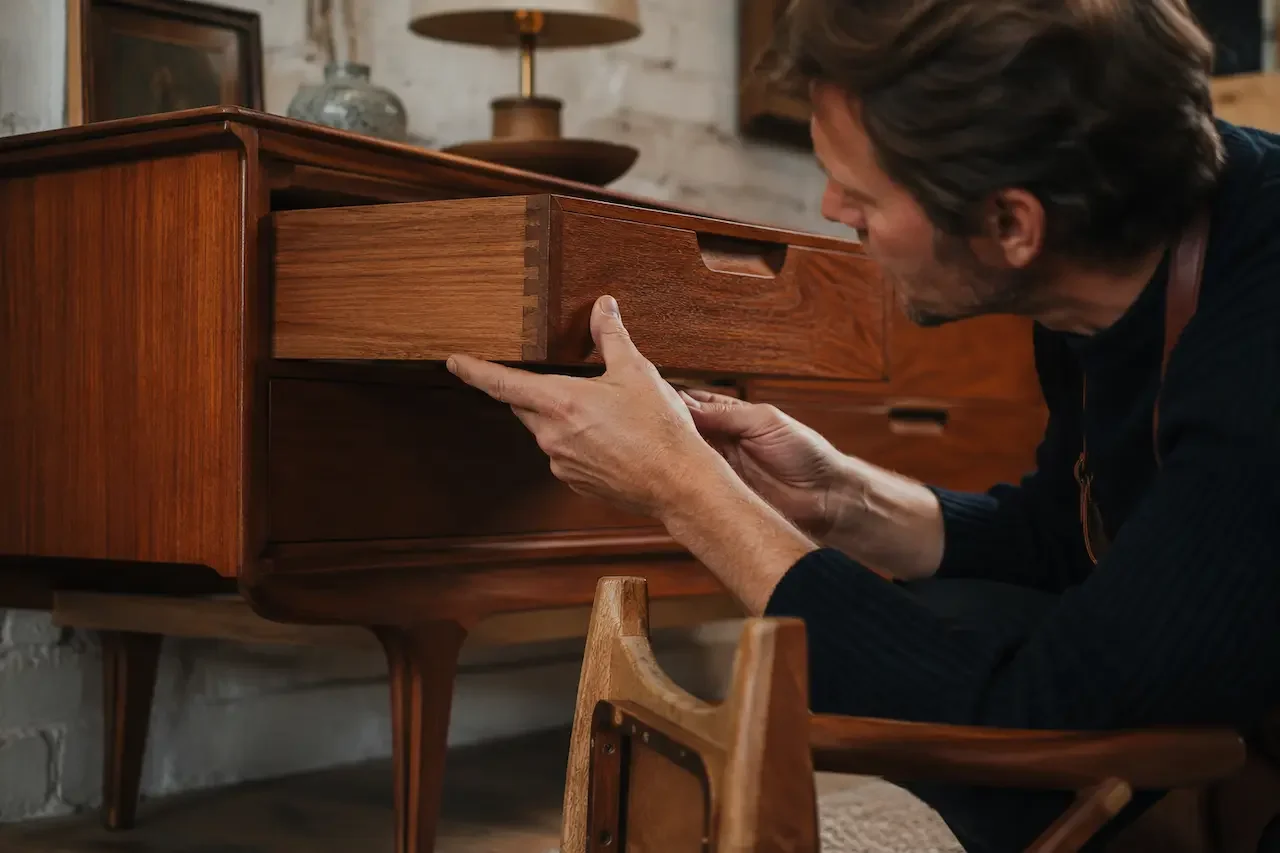
Construction quality is also important. Genuine mid-century pieces often show thoughtful joinery, proper drawer construction, quality timber selection, and hardware that matches the period. The back panels, underside, and internal framework can reveal just as much as the visible surfaces.
Timber choice matters as well. Teak, walnut, rosewood, oak, and Australian timbers were commonly used in different mid-century furniture styles. The grain should look natural and appropriate for the age of the piece.
The hardware should also make sense. Handles, hinges, runners, screws, and brackets can help confirm whether the piece has been altered. Modern replacement hardware does not always mean the furniture is fake, but it should be noted during assessment.
I look at authenticity as a combination of evidence. A makers mark may support the story, but construction details often confirm whether that story is believable.
What If the Label Is Missing
A missing label does not automatically mean a piece is not authentic. Many genuine mid-century pieces have lost their labels through cleaning, refinishing, humidity, repair work, or everyday use.
This is especially common with paper labels. Over decades, adhesives dry out and labels fall away. Sometimes previous owners remove them without realizing their value. In other cases, restoration work may have accidentally removed surface markings.
When a label is missing, the next step is to examine the design, materials, joinery, dimensions, hardware, and signs of age. These clues can still provide a strong indication of authenticity.
A missing label may affect certainty, but it does not always remove value. Some unmarked pieces are still highly desirable because of their design quality, craftsmanship, and condition.
This is why I always advise against dismissing a piece too quickly. A careful inspection can often reveal more than a visible label alone.
Warning Signs of Reproduction or Misidentified Furniture
Not every piece described as mid-century is genuinely mid-century. Some furniture is inspired by the era but produced much later. Other pieces may be vintage but not true MCM in design or construction.
Warning signs include overly new hardware, artificial distressing, inconsistent construction, modern screw types throughout, poor-quality veneer, plastic-looking finishes, or proportions that feel copied rather than original.
Another warning sign is a label that looks too new compared with the rest of the furniture. Labels can be added later, so they should always match the age, wear, and material condition of the piece.
Be cautious when a seller relies only on one claim without supporting evidence. A phrase such as “mid-century style” is not the same as authentic mid-century furniture. Style can be reproduced, but age, construction, and maker history require closer inspection.
I always encourage clients to take their time before buying or restoring a piece. Once money is spent or restoration begins, it becomes harder to reverse a poor decision.
Why Restoration Should Be Careful After Identification
Once you identify a genuine mid-century piece, the next decision is how to care for it. This is where many valuable items lose character. Aggressive sanding, thick modern coatings, repainting, or replacing original components can reduce authenticity.
If a piece has makers marks, labels, or original surface details, they should be protected during any restoration work. Even areas that are not visible during everyday use can hold important evidence of age and maker history.
Before refinishing, repairing, or polishing a genuine piece, it is worth understanding whether mid-century furniture can be restored without losing value. The safest approach is usually preservation first, correction second, and replacement only when necessary.
My goal is always to keep as much original material as possible. I'm not trying to erase the history of the piece — I'm restoring stability, usability, and appearance while protecting the details that make the furniture important.
Common Mistakes People Make When Checking Makers Marks
The biggest mistake is rushing the inspection. People often turn furniture over quickly, wipe surfaces with strong cleaners, or scrape at marks to make them clearer. These actions can permanently damage important evidence.
Another mistake is relying on a single online image comparison. Many mid-century designs have similar shapes, and later reproductions can look convincing in photos. A true assessment should include material, construction, scale, hardware, and finish.
Some people also assume that every authentic piece must have a famous designer name. That is not true. Many genuine mid-century pieces were produced by quality manufacturers or regional workshops without being attached to a widely known designer.
I also see owners make restoration decisions too early. They find a piece, assume it has low value because it looks worn, and start sanding before checking for marks. This can remove stamps, original finish, and important character.
My approach to mid-century restoration with restraint explains why careful preservation is often more valuable than trying to make an old piece look completely new
When to Get a Professional Assessment
A professional assessment is worthwhile when the furniture appears valuable, has unclear markings, shows signs of previous restoration, or contains labels that may be fragile. It is also important if you are planning to buy, sell, insure, restore, or refinish the piece.
Bring clear photos of the full item, close-ups of marks, drawer interiors, backs, undersides, joints, legs, hardware, and any damage. These details help form a more accurate view before the furniture is handled.
I assess every piece as a whole, weighing marks, construction, timber, condition, design and restoration risk together. That gives clients a clearer understanding of what they own and how it should be cared for.
If you have found a stamp, label, or marking and are unsure what to do next, you can contact our Melbourne restoration experts before cleaning or refinishing the piece.
Professional advice is especially helpful when the mark is faint, the piece has veneer, or the furniture may have collectible value.
Assessing Marks and Provenance for Melbourne Clients
Melbourne has a genuinely strong mid-century collector market, and a lot of the pieces I assess in my Northcote workshop have travelled through several homes across the inner north before reaching me. If you've picked up a piece from an estate sale, a Fitzroy or Northcote market, or inherited furniture with no paperwork, a proper marks-and-construction assessment before any cleaning or restoration is the safest first step it protects whatever value or history is still there to find.
Conclusion
Learning how to identify authentic MCM furniture starts with makers marks, stamps, and labels, but it should never end there. These details are important clues, yet the full picture comes from looking at construction, materials, design, hardware, condition, and provenance.
Mid century furniture makers marks can confirm history, support value, and guide restoration decisions. However, missing labels do not always mean a piece is not genuine, and visible labels should always be checked against the rest of the furniture.
Working out of Northcote, I believe authentic mid-century furniture should be assessed carefully and restored with respect. The goal is always to protect original character, preserve value, and keep quality craftsmanship alive for future use.
Why Choose Us
I provide careful mid-century furniture assessment and restoration guidance focused on preserving original value, maker history, and craftsmanship.
Understanding of makers marks, stamps, labels, and construction clues
Every piece assessed as a complete story, not by one visible mark alone
Original labels and surface details protected during restoration
Preservation prioritized over unnecessary alteration
Informed restoration guidance for clients across Melbourne
Genuine mid-century furniture restored with patience and care
Frequently Asked Questions
What are mid-century furniture maker’s marks?
Mid-century furniture maker’s marks are labels, stamps, metal badges, impressed marks or handwritten production codes found on a piece of furniture. They may identify the manufacturer, designer, retailer, model number, country of origin or approximate production period.
Where are maker’s marks usually found on mid-century furniture?
Maker’s marks are commonly found underneath tables, inside drawers, on the backs of cabinets, beneath chair seats or along drawer runners. They may also appear inside cupboard doors, behind removable panels or on the underside of upholstered furniture frames.
Does a missing label mean the furniture is not authentic?
No. Genuine mid-century furniture may lose its original label because of age, cleaning, moving, repairs or previous refinishing. Authenticity can still be assessed by examining the design, timber, construction methods, hardware, joinery and natural signs of age.
How do I identify authentic MCM furniture?
Look at the maker’s marks, construction quality, timber species, proportions, hardware, joinery, finish and overall design language. Authenticity is usually determined by several consistent details rather than one label or feature, so a professional assessment may be helpful for valuable or unclear pieces.
Can restoration remove maker’s marks?
Yes. Aggressive sanding, chemical stripping, heavy cleaning or careless refinishing can remove stamps, paper labels and original surface details. The entire piece should be inspected and photographed before restoration begins so important identifying evidence can be protected.